云计算 阅读材料 17 Case Studies - Cloud Object Storage
本页目录
Now that we have covered specific file systems and database implementations, we turn our focus to object storage. Object storage is an important facet in cloud storage, and is one of the earliest public cloud computing services to emerge (case in point: Amazon S3).
Object storage is particularly important in web services. where static web content (images, videos and other files) can be stored in a place that is easily accessible to web clients. This allows the management and complexity of scaling, redundancy and accessibility of such storage systems to be abstracted away from a web application developer, choosing instead to work with a simple API to store and access such data. Another example of applications that benefit from object storage services are websites which feature a lot of user-generated content (such as social networks).
Amazon S3, OpenStack Swift
Amazon S3
Amazon Simple Storage Service (S3) is one of the first cloud-based storage services to have been offered to the public in 2006. Being a proprietary service, S3's architecture has not been made public but is known to be implemented on top of Amazon's (Dynamo architecture).
Amazon S3 Data Model
As discussed previously, S3 structures data into buckets and objects. A bucket is a container for an object in S3, and every object must be contained in a bucket. Buckets are identified by a unique string, called a bucket name. Bucket names must be globally unique and must conform to certain specifications set by Amazon so that they can be accessed through an HTTP URL.
An S3 object is the fundamental entity stored in S3 and consists of an object's data and metadata. The data stored in an object is opaque to S3 and can be binary information from 1 byte to 5 terabytes in size.
Objects are referenced by a key, which is the sole identifier for an S3 object. Although S3 allows users to create folders in a bucket, they are, in fact, part of the object's key string. For example, assume an S3 object is referenced by either of the following URLs:
In this example, the bucket name is somebucket, and the key name is somefile.txt. The object is the binary information that is associated with the course/test.txt key (in a file system context, it can be considered to be the contents of the file).
Operations on Data in S3
At the lowest level, S3 allows operations on buckets and objects using a REST- or SOAP-based interface. REST commands are implemented using the standard HTTP commands of GET, PUT, POST, HEAD, OPTIONS, and DELETE. The operations of these commands are context sensitive. For example, a GET operation on a bucket, by default, lists all of the objects stored in the bucket (similar to a file system list operation), and a GET operation on an object retrieves the object data. A complete list of S3 operations is available in the API reference (S3API).
Amazon also introduced versioning support for objects in S3 in 2010. Versioning can be enabled on a per-bucket basis, and all objects in the bucket will be versioned. Existing objects will be preserved during PUT, POST, COPY, or DELETE operations, and GET operations can get any version of a bucket or an object if a version number is specified in the request header.
Consistency Model in Amazon S3
Amazon guarantees that any updates to a single key are atomic, which means that after a particular data item is stored on S3, subsequent reads may return some version of that data but never a corrupted or partially updated version of that data. Data stored in S3 are automatically replicated to multiple availability zones for redundancy. However, this also means that the replicas have to be made consistent over time. Amazon S3 is mainly an eventually consistent data store (exceptions are described below), meaning that updates to data stored in S3 will eventually become consistent if given a long enough time period during which no other operations on that data take place. By sacrificing strong consistency, S3 can be classified as an available, partition-tolerant (AP) distributed data store, according to the CAP theorem. According to S3 documentation (S3), the US-Standard Region provides eventual consistency for all requests. All other regions provide read-after-write consistency for PUTs of new objects and eventual consistency for overwrite PUTs and DELETEs.
Amazon's documentation states that the following scenarios may take place due to S3's eventual consistency model:
- A process writes a new object to Amazon S3 and immediately attempts to read it. Until the change is fully propagated, Amazon S3 might report "key does not exist."
- A process writes a new object to Amazon S3 and immediately lists keys that are in its bucket. Until the change is fully propagated, the object might not appear in the list.
- A process replaces an existing object and immediately attempts to read it. Until the change is fully propagated, Amazon S3 might return the prior data.
- A process deletes an existing object and immediately attempts to read it. Until the deletion is fully propagated, Amazon S3 might return the deleted data.
- A process deletes an existing object and immediately lists keys that are in its bucket. Until the deletion is fully propagated, Amazon S3 might list the deleted object.
Amazon documentation also states that simultaneous writes to an object in S3 are settled by honoring the write with the latest timestamp. Thus, application developers using S3 must consider these scenarios and design their applications accordingly.
OpenStack Swift
OpenStack Swift is an object storage service that is part of the OpenStack cloud platform. Swift offers clients a REST-based HTTP interface to interact with binary objects, much like S3. However, unlike S3, Swift is free and open source, and is available for anyone to install and configure on any machine, effectively providing object storage on both public and private clouds.
Swift Data Model and APIs
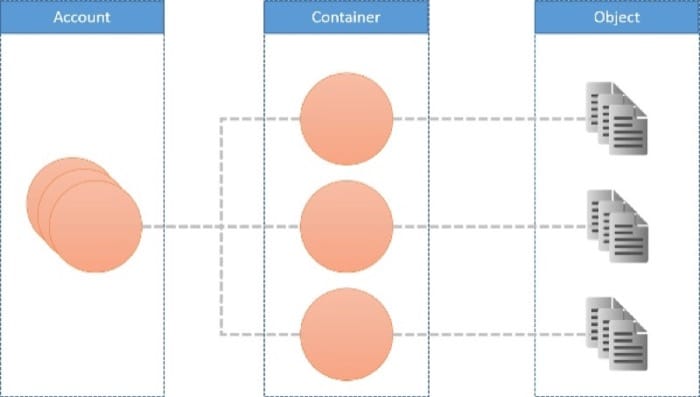
In Swift, users have access to an account, which can be used to define containers, which can be used to store objects. As an example, assume a user with an account123456 on the swift service running on swift.mycloud.com, stores the object namedpicture.jpg in the container images. The full path to access an object in this example would thus be:
https://swift.mycloud.com/v1/123456/images/picture.jpg
As Swift uses a RESTful interface, it uses the standard HTTP access verbs like GET,PUT and POST. Since the SWIFT API is modelled on the S3 API, the mechanism of the API and the supported operations are similar. Commands are stateless and sensitive to the context in which they are applied. A GET command on a container lists all the objects stored in that container, while a GET command on an object will retrieve that object. A complete list of Swift operations is available in the API reference (Swift API). It must be noted that S3 and SWIFT are not 100% API compatible. For example, S3 API requests that are related to billing and AWS regions are not replicated in swift.
It must be noted that Swift also supports authenticated access of users trying to access the service (as unauthenticated, public access of a Swift service). Swift integrates into OpenStack's own authentication service, called Keystone.
Swift Architecture
Swift uses a multi-tiered architecture in the interest of performance, fault-tolerance, reliability and durability. Like other distributed data stores, Swift uses replication for fault tolerance. As indicated in the discussion of Swift's API, Swift has to maintain information regarding accounts, containers and objects. Thus Swift runs independent processes to keep track of the information regarding each of these layers in the cluster.
The different components of the SWIFT architecture are as follows:
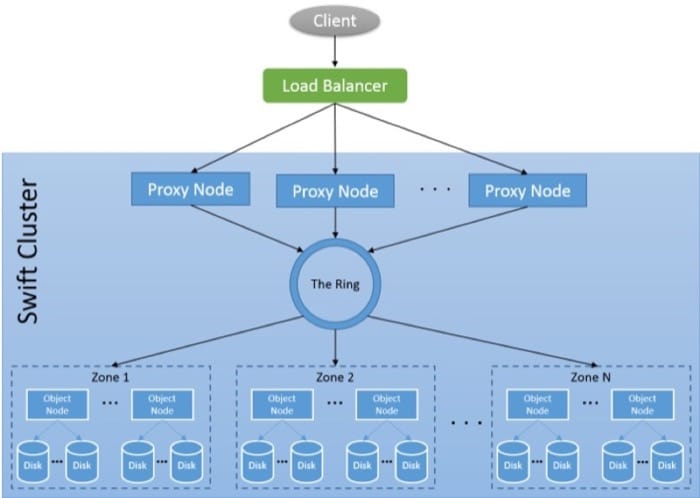
Proxy Nodes: These are the front-end servers which process incoming API requests. A Swift cluster can have multiple proxy servers to handle bigger loads of incoming requests. The proxy server determines the downstream server to send the request to. Proxy servers also coordinate responses and handle failures.
Object Nodes: These are the actual object storage devices which can store or retrieve objects.
Zones: Swift allows availability zones to be configured to isolate failure boundaries. Each replica of the data resides in a separate zone, if possible. At the smallest level, a zone could be a single object server or a grouping of a few object servers. Zones are used to organize server and partitions such that the system can tolerate at least one failure per zone without any loss of data or service availability.
Data Placement in Swift
Rings: A ring represents a mapping between the names of account/container/objects and their physical location. There are separate rings for accounts, containers, and one object ring per storage policy (explained below). When other components need to perform any operation on an object, container, or account, they need to interact with the appropriate ring to determine its location in the cluster. The Ring maintains this mapping using zones, object servers, partitions, and replicas. Each partition in the ring is replicated, by default, 3 times across the cluster, and the locations for a partition are stored in the mapping maintained by the ring. The ring is also responsible for determining which devices are used for handoff in failure scenarios.
Partition: Swift uses consistent hashing to determine which object nodes in a zone have to store which objects. Each part of the consistent hashing ring is known as a partition. Storage Policy: Storage Policies provide a way for object storage providers to differentiate service levels, features and behaviors of a Swift deployment. Each Storage Policy configured in Swift is exposed to the client via an abstract name. Each device in the system is assigned to one or more Storage Policies. This is accomplished through the use of multiple object rings, where each Storage Policy has an independent object ring, which may include a subset of hardware implementing a particular differentiation. Using storage policies, a cloud provider can provide a fast SSD-based access to objects for one client with a higher SLA, while providing traditional disk-based storage for another client with a different SLA.
Let us now look at an example of how object operations are performed in Swift. Let's assume a client request consists of an object PUT request to a particular container. The request is first received by a proxy node, which will first authenticate the request to ensure appropriate access. The proxy server will then take the hash of the object name and look up all three partition locations, the drives, of where the data should be stored using the object ring. The process then uses the object ring to look up the IP and other information for those three devices.
Having determined the location of all three partitions, the proxy server process sends the object to each storage node where it is placed in the appropriate partition. When a quorum is reached, in this case at least two of the three writes are returned as successful, then the proxy server process will notify the client that the upload was successful. Thus Swift uses Quorum writes as a consistency mechanism. Finally, the container layer is updated asynchronously to reflect the new object in it.
Consistency Model in Swift
Swift is designed to be an eventually consistent system. All data in swift is replicated across Zones, and objects are versioned as well. Swift runs special purpose processes called replicators, which monitor the state of accounts, containers and objects. If it finds a new entity or an updated version of an entity, it ensures that the data is replicated to other servers according to the replication policy of the cluster.
Swift also employs special processes called auditors, which scan through the data stored in a swift cluster to ensure that they have not been compromised. The auditor recomputes a checksum for each object to ensure they match. If there's any discrepancy, the object is moved to a quarantine area and the storage administrator is notified to investigate.
Ceph Object Gateway
To end our discussion on cloud object stores, we should talk about the Ceph Object Gateway, also known as RADOSGW. RADOSGW is an additional layer over the Ceph Storage Cluster (RADOS) that provides a RESTful HTTP interface to interact with objects stored on RADOS. The Ceph object gateway is unique in its ability to support both the S3 and SWIFT APIs to allow applications to be migrated to that platform. RADOSGW replicates the data models used in S3 and Swift and provides the more or less the same functionality as either of those services.
Summary
- Amazon Simple Storage Service (S3) is an online file storage Web service offered by Amazon Web Services.
- S3 structures data into buckets and objects; a bucket is a container for objects in S3, and objects consist of the binary data of the object as well as metadata. Buckets and objects are accessed by a string, called bucket name, and object key, respectively.
- The data stored in a single object in S3 can be between 1 byte and 5 terabytes in size.
- S3 supports simple create, read, update, and delete options through a RESTful interface.
- S3 utilizes eventual consistency, and developers must account for several scenarios where stale data might be accessed.
- OpenStack Swift is an open-source object storage system that be deployed in public or private clouds.
- Swift proves an S3-like REST interface to access objects.
- Ceph object gateway is a access layer over the RADOS distributed object store. This offers both S3 and SWIFT compatible interfaces into RADOS.